Mitsubishi SPVF
| In-production | 1985 to early 1990s | Status | Discontinued |
| Predecessor | Mitsubishi SP-III | Successor | Mitsubishi GPS |
Overview
SPVF (some sources may also claim it as SP-VL) was a standard passenger traction elevator model of Mitsubishi for low to mid rise buildings. Launched in 1985, it was Mitsubishi's first elevator model with a variable voltage and frequency (VVVF) inverter control and was designed for low to mid rise commercial and residential buildings. Mitsubishi claimed that the SPVF have lower power consumption and smoother ride compared to their previous models[1]. It was sold until around the early 1990s and was succeeded by the Mitsubishi GPS.
The SPVF model uses VVVF inverter with a power transistor as its inverter module, and a 8-bit microprocessor controller with a centralized distribution control system. The speed range is between 0.75 and 1.75 meters per second, and the capacity range is between 450 and 1000 kilograms[2].
It is based on the Mitsubishi Elepet Advance V elevator that was exclusively sold in Japan from 1982[3] until the early 1990s. Some elevator enthusiasts often mistaken the SPVF as Elepet Advance V, in reality, the Elepet Advance V was only sold in Japan and the SPVF was a model based on the Elepet Advance V sold for overseas markets.
Chronologically, SPVF was the fourth and final model of the Mitsubishi SP, a series of standard passenger elevator models for export markets. It was a successor of Mitsubishi SP-III.
In Indonesia, it is usually seen in low rise office buildings and hotels with less than 10 floors. Many existing installations have been modernized into Mitsubishi ELEMOTION, so it is now relatively difficult to find one in original condition.
Characteristics
- SPVF elevators produce a very loud variable frequency (VF) noise during operation.
- Compared to the previous models, the ride quality of SPVF elevators is smoother due to the application of VVVF inverters.
- Car station is mounted on the corner between the car door and side wall (45 degrees corner-fit type).
- The floor number on the internal floor indicator flashes upon arrival (standard feature).
- Most elevators will automatically return to the ground/main floor after they have served the last call[4].
- Some elevators are equipped with Mitsubishi Emergency Landing Device (MELD)[5] which is usually indicated by a sign above the car station or door.
- Arrival chime is a bell sound.
Quick specifications
- Type: Traction, with machine room
- Use: Passenger, service, bed/stretcher
- Drive: AC geared with VVVF
- Control system: Microprocessor, Mitsubishi VFCL
- Capacity: 450-1000 kg
- Max. landings: 32
- Max. travel height: 105 m
- Speed: Typically 1 m/sec
- Max elevator car: 3
- Doors:
- Single speed center opening
- 2 speed telescopic sliding
- Fixtures: No official name (refer to next section below for details)
Fixtures
SPVF elevators use dark brown colored operating panels except for landing call buttons without a floor indicator. The car station is positioned in the corner between the front return panel and side wall (45 degrees angled).
Buttons
The buttons are dark brown plastic square buttons with orange illuminating number.
-
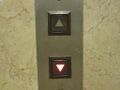 Call buttons
 -
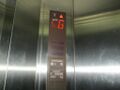 Car floor indicator
 -
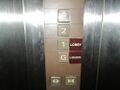 Car station buttons
 -
 Typical Mitsubishi SPVF car station. The panel is angled 45 degrees between the car door and side wall.
 -
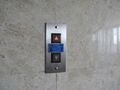 Typical Mitsubishi SPVF call station.


Floor indicators
The floor indicator uses a 16-segments digital display with triangle arrows. The car floor indicator is integrated with the car station and the floor number flashes upon arrival. It has two segments displays by default, and even if there are only a few floors only the segment on the right is used.
The landing floor indicator is also segmented display and is mounted above the landing door. Some elevators have analog indicators outside, either on the landing station or above the landing door. They are usually found in low rise buildings with less than 10 floors.
-
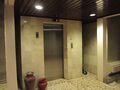 A Mitsubishi SPVF elevator from 1990 in Bali.
 -
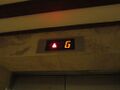 Landing floor indicator.


Hall lanterns
Triangle shaped arrows which light up and do not flash. Some elevators may have a combination of hall lanterns and floor indicator, usually found on the main floor.
-
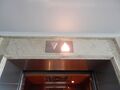 Hall lanterns

Known installations in Indonesia
Jakarta
- Mercure Jakarta Ancol Hotel & Convention Center (1991, extension wing)
- Badan Pengkajian dan Penerapan Teknologi - B.J. Habibie Building (1993, car park)
- Wisma Nugraha, Menteng
- Jaya Teknik Building, Kebon Sirih
- Tatamas Building
- Palma One (1993, car park and VIP elevator)
- Paviliun Mahakam, Blok M
- Total Building, Tomang (1991)
- Granadi Building (1992)
- Badan Pusat Perbendaharaan Negara
- Badan Kebijakan Fiskal - R.M. Notohamipradojo Building
- Bank Central Asia (BCA) - Matraman Branch
- Bank Central Asia (BCA) - Pluit Branch
- Bank Central Asia (BCA) - Asemka branch[6]
- Wisma Keiai (1993, car park)[6]
- KPP PMA 4 Kalibata
- Ministry of Foreign Affairs (1991, current status is unknown)
- Wisma Barito Pacific (1990)[6]
Other cities/provinces
- Prama Grand Preanger Hotel, Bandung (1993, modernized by another company)
- Horison Ultima Bandung, Bandung (1993)
- Wisma Bumiputera, Bandung (1992)
- Graha Bumiputera, Surabaya
- Bintang Bali Resort, Bali (1990)
- InterContinental Bali Resort, Bali (1993)[6]
- The Westin Nusa Dua, Bali (1991, four have been modernized into Mitsubishi ELEMOTION)
Inna Grand Bali Beach Hotel, Sanur, Bali(1993-2022)[7]- Sinarmas Land Plaza Medan, Medan[6]
Shanghai Mitsubishi SPVF
SPVF was also produced by Mitsubishi's Chinese subsidiary Shanghai Mitsubishi from 1987 until the late 1990s. Other than the different brand name, the design was the same. These elevators are extremely rare in Indonesia.
Known installations in Indonesia:
- Paragon Hotel Menteng, Jakarta (slightly modernized)
- Palembang Trade Center (PTC), Palembang


Trivia
- SPVF was the first Mitsubishi elevator model to adopt a flashing number on the interior floor indicator, in which the number will flashes when the elevator arrives.
Gallery
-
 A Mitsubishi SPVF elevator from 1990.
 -
 Traction machine of a Mitsubishi SPVF elevator from 1990.
 -
 Another view of the traction machine.
 -
 Controller cabinet of a Mitsubishi SPVF elevator from 1990. The shorter cabinet on the right is most likely a Mitsubishi Emergency Landing Device (MELD).
 -
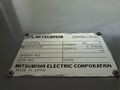 Specification plaque of a Mitsubishi SPVF controller (VFCL type) from 1990.
 -
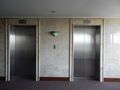 Two of the three Mitsubishi SPVF elevators from 1993 at Grand Inna Bali Beach Hotel in Bali. As of 2022 these elevators no longer exist (photo taken in 2015).


Videos
Notes and references
- ↑ Shigehiko Suzuki, Kenji Shiro (December 1984) "SERIES SP-VF STANDARD ELEVATORS WITH VVVF MOTOR-DRIVE CONTROL." - ResearchGate (Archived)
- ↑ S Suzuki, S Iwata and M Yonemoto (1996) "NEW TECHNOLOGIES FOR ELEVATOR CONTROL SYSTEM" - The Lift and Escalator Library
- ↑ Milestones - Elevators & Escalators - Mitsubishi Electric (archived)
- ↑ Mitsubishi Traction Elevator at Westin Resort, Bali (Lift 10) - YouTube
- ↑ MELD is Mitsubishi's automatic elevator rescuing device which allows an elevator to proceed to the nearest floor using rechargable batteries in case of power failure, therefore preventing passengers from getting trapped in the elevator for too long.
- ↑ 6.0 6.1 6.2 6.3 6.4 Modernized into Mitsubishi ELEMOTION.
- ↑ Replacement from unknown 1960s elevators after a fire in 1993. Replaced again into Marohn TKE elevators in 2023.
External links and resources
- Shigehiko Suzuki and Kenji Shiro (1984). "Series SP-VF Standard Elevators with VVVF Motor-Drive Control". Mitsubishi Electric Advance: Vol. 29, December 1984, Page 27-29
- SP-VF (Chinese) - Shanghai Mitsubishi Elevator Co. Ltd. (Archived)
| Mitsubishi elevator models | |
|---|---|
| Models currently in-production | PS: ELEMOTION • Elenessa Series IP/AP Version2 • NEXIEZ (NEXIEZ-MR • NEXIEZ-MRL • NEXIEZ-MRL Version2 • NEXIEZ-S • NEXIEZ-Fit) • NexWay-S Package R • NexWay-S Series IP/AP Version2 and Series IP • SHA/SVC HS: ELEMOTION • NexWay FR: GFC-L2 & GFC-L3 • GFM-T |
| Discontinued models |
PS: Elenessa • EP series • GPQ • GPS/GPS-II/GPS-BII • GPS-III/GPS-BIII/GPS-IIIMZ • GPX • MP Type (1980s) • MP-III • NexWay-S Series AW • SP series (SP Type, 1970s • SP-II • SP-III • SPVF) HS: GPM & GPM-II • GPM-III/GPM-IIIMZ • NexWay Modernization FR: MF Type |
| Unidentified models (models have no confirmed names) |
PS: Hydraulic passenger/freight model HS: High speed model (1970s-1980s) • High speed model (1990s) |
| Destination dispatch | DOAS |
| Remarks | (PS) Passenger model (traction with or without machine room / hydraulic) • (HS) High speed passenger model • (FR) Freight or heavy duty model |
| Shanghai Mitsubishi elevator models | |
|---|---|
| Models currently in-production | PS: Elenessa-LZ • LEGY-III • LEHY-III / LEHY-III-B / LEHY-III-S • LEHY-MRL-II / LEHY-MRL-G HS: LEHY-M-II FR: LEHY-MRL-G |
| Discontinued models |
PS: Elenessa • GPS / GPS-BII • GPS-CR • GPS-III / GPS-BIII • HOPE-II / HOPE-IIB • LEHY-II • LEHY-MRL • SPVF HS: LEHY-M FR: CIC-V • HOPE-IIG • SG-VF |
| Unidentified models (models have no confirmed names) |
- |
| Destination dispatch | To be confirmed |
| Remarks | (PS) Passenger model (traction with or without machine room / hydraulic) • (HS) High speed passenger model • (FR) Freight or heavy duty model |
