Mitsubishi GPS-III
| In-production | 1997 to Mid 2000s | Status | Discontinued |
| Predecessor | Mitsubishi GPS | Successor | Mitsubishi NexWay-S Series-IP and AP (for GPS-III) Mitsubishi ELEMOTION (for GPS-IIIMZ) |
This article should not be confused with Mitsubishi GPS, which is the predecessor model.
Overview
GPS-III is a passenger elevator model of Mitsubishi that was produced from 1997 until the mid 2000s. It is a low to medium speed geared traction model for low to high rise buildings, and is basically a successor and improvement of the Mitsubishi GPS & GPS-II model. It was discontinued in the mid 2000s and was succeeded by the Mitsubishi NexWay-S Series AW.
It was also produced by Mitsubishi's Chinese subsidiary, Shanghai Mitsubishi in Shanghai, China. The design remained the same except for the brand name and very few other features.
In Indonesia, this model was mainly installed in shopping centers (particularly ITC trade centers in Jakarta), high rise apartment buildings and occasionally hospitals built between the late 1990s and early 2000s.
Characteristics
- GPS-III is mechanically almost similar to its predecessor GPS. Like most Mitsubishi models, it runs very smooth and levels quick. It usually has a loud motor sound when it starts up. It has been known that a spring like mechanical sound is often heard when the doors are opening and closing.
- Car design is similar to GPS, with a slightly angled COP for standard specifications. Even if the other panel lacks a button panel it remains angled. Elevators with angled COPs always have slim door sills, while those with non-angled panels have thick door sills.
- Starting from this model, the arrival chime will sound when the call button is repeatedly pressed on arrival.
- Also starting from this model, the direction arrow on the landing floor indicator will flashes upon arrival. In addition, the overhead landing floor indicators now have different LED dot matrix pattern.
GPS-BIII
Released in 1999, this is a bed elevator variant of the GPS-III for hospitals. It could also be used as a service elevator in shopping centers, hotels and residential buildings. Its successor is NexWay-S Series AW Hospital, a bed elevator variant of NexWay-S.
GPS-IIIMZ
GPS-IIIMZ is a variant of GPS-III for modernization of old Mitsubishi elevators. It was released in 1999 and discontinued in the late 2000s. Its successor is Mitsubishi ELEMOTION, Mitsubishi's current modernization model since 2001.
Known installations in Indonesia:
- grandkemang Hotel, Jakarta (originally from 1974)
- Wisma Indocement, Jakarta (originally from 1984, might have been modernized again by Mitsubishi)
Shanghai Mitsubishi GPS-III and GPS-BIII
Shanghai Mitsubishi, Mitsubishi's Chinese subsidiary, also produced the GPS-III and GPS-BIII models under their own brand. The design was the same except for the brand name.
Known installations in Indonesia:
- Mall Taman Palem, Jakarta (scenic elevators)
- Mangga Dua Square, Jakarta (service elevators)
Plaza Kenari Mas, Jakarta(replaced into Mitsubishi NEXIEZ-MR elevators in the 2010s)
Quick specifications
The following specifications below are for GPS-III and GPS-IIIMZ. Specifications for GPS-BIII are currently not listed here due to a lack of data.
- Type: Traction, with machine room
- Use: Passenger, service, bed/stretcher
- Drive: AC geared with VVVF
- Control system: Microprocessor, Mitsubishi VFEL (for GPS-III)
- Capacity: 410-2450 kg
- Max. landings: 36
- Max. travel height: 120 m
- Speed: Up to 150 m/min
- Max elevator car: 8
- Doors
- Single speed center opening
- 2 speed telescopic sliding
- 2 speed telescopic center opening
- Fixtures: No official name (refer to next section below for details)
Fixtures
The fixtures used in GPS-III, GPS-BIII and GPS-IIIMZ elevators are basically redesigned and simplified from the ones used in the GPS elevators. Likewise, there were two types of button panels; stainless steel and dark grey resin. The latter is known as "Wavelive Panel" due to its unique wave-like design and was the standard panel. In most cases, the COP is slightly angled close to the car door. Extra COP for wheelchair is horizontal and mounted on the side wall.
Square buttons (M type)
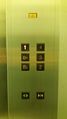
Square micro click plastic buttons with orange light. These are the standard buttons, and are known as M type.
-
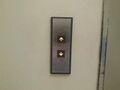 Surface mounted LOP with square buttons.
 -
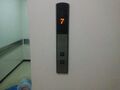 Surface mounted LOP (for one elevator) with square buttons.
 -
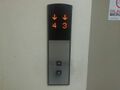 Surface mounted LOP (for two elevators) with square buttons.
 -
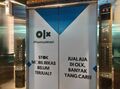 Interior of a Mitsubishi GPS-III elevator at WTC Mangga Dua, Jakarta with "waveline" COPs.
 -
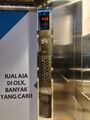 The standard "waveline" COP.
 -
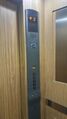 The standard "waveline" COP in Bandung.
 -
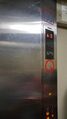 Stainless steel COP.
 -
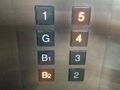 Standard square buttons, known as M type.
 -
-
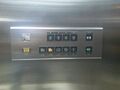 Extra COP for wheelchair.


Vandal resistant buttons
These are round grey buttons with a small orange light and number beside them, and are believed to be known as M type as well. They could not be used in "waveline" panels. They are extremely rare in Indonesia, and so far they can be found in Somerset Permata Berlian, Jakarta[1] and Tunjungan Plaza 4, Surabaya.
-
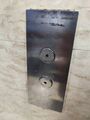 Vandal resistant call buttons.
 -
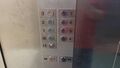 Vandal resistant buttons used in Tunjungan Plaza 4, Surabaya.


Floor indicators
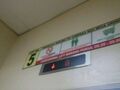
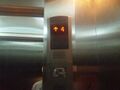
Orange LED dot matrix display. The car floor indicator is now integrated with the button panel. Overhead landing floor indicators now have slightly different LED dot matrix pattern.
-
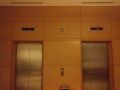 A set of two Mitsubishi GPS-III elevators at Grand Surya Hotel, Kediri.
 -
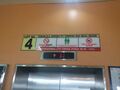 Overhead landing floor indicator.
 -
-
-
-
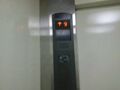 Car floor indicator, waveline panel.
 -
-
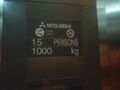 Capacity
 -
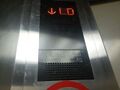 Car floor indicator, stainless steel panel.
 -
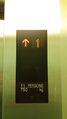


Hall lanterns
Clear acrylic-like square blocks which flash upon arrival. They have an arrow that sits behind the glass block. Some elevators may have an overhead landing floor indicator combined with hall lanterns, usually on the main floor.
-
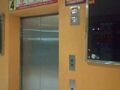 A Mitsubishi GPS-III elevator with hall lanterns and two call stations (one is for wheelchair)
 -
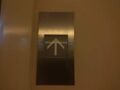 Standard hall lantern (up, unlit)
 -
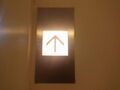 Standard hall lantern (up, lit)
 -
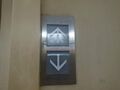 Standard hall lanterns (both direction)


Notable installations in Indonesia
Jakarta
- Almost all ITC shopping centers across Jakarta, these include:
- ITC Kuningan (2002)
- ITC Cempaka Mas (2001)
- ITC Permata Hijau
- ITC Fatmawati (2001)
- WTC Mangga Dua (2001)
- Harcomas Mangga Dua (2002)
- Mal Mangga Dua (additional scenic elevator at the rear atrium)
- Somerset Permata Berlian
- The Papilion Kemang (2006)
- SCBD Suites (2004)
- Kobexindo Tower (formerly Menara Cordova) (2002)
- Mintoharjo Navy Hospital
- Royal Taruma Hospital
Bandung
- Bandung Electronic Center (old building)
- Bandung Trade Center
- Hasan Sadikin Hospital
Surabaya
- Tunjungan Plaza 4
- Empire Palace
- Wisma Halim Sakti
Bali
- The Royal Pita Maha Resort (2003)
- BIMC Hospital Kuta
- Jalan Raya Kerobokan No. 100X
- Wangaya Hospital - Pavilion Praja Amerta, Denpasar
Other cities/provinces
- Panti Rapih Hospital, Yogyakarta
- Grand Surya Hotel, Kediri
- Sun Plaza, Medan
Trivia
- One of the tallest known Mitsubishi GPS-III installations in Indonesia is in the residential tower of ITC Kuningan (Apartemen Kuningan 2) in Jakarta, which serve more than 30 floors.
Videos
See also
- Mitsubishi GPS - the predecessor of GPS-III
- Mitsubishi GPX - a low cost model based on the GPS-III
External links and resources
- Series GPS-III Passenger Elevators - Mitsubishi Electric Elevator and Escalator (Archived)
- GPS-III (Chinese) - Shanghai Mitsubishi Elevator Co. Ltd. (Archived)
- GPS-BIII (Chinese) - Shanghai Mitsubishi Elevator Co. Ltd. (Archived)
- GPS-IIIMZ brochure (Archived)
| Mitsubishi elevator models | |
|---|---|
| Models currently in-production | PS: ELEMOTION • Elenessa Series IP/AP Version2 • NEXIEZ (NEXIEZ-MR • NEXIEZ-MRL • NEXIEZ-MRL Version2 • NEXIEZ-S • NEXIEZ-Fit) • NexWay-S Package R • NexWay-S Series IP/AP Version2 and Series IP • SHA/SVC HS: ELEMOTION • NexWay FR: GFC-L2 & GFC-L3 • GFM-T |
| Discontinued models |
PS: Elenessa • EP series • GPQ • GPS/GPS-II/GPS-BII • GPS-III/GPS-BIII/GPS-IIIMZ • GPX • MP Type (1980s) • MP-III • NexWay-S Series AW • SP series (SP Type, 1970s • SP-II • SP-III • SPVF) HS: GPM & GPM-II • GPM-III/GPM-IIIMZ • NexWay Modernization FR: MF Type |
| Unidentified models (models have no confirmed names) |
PS: Hydraulic passenger/freight model HS: High speed model (1970s-1980s) • High speed model (1990s) |
| Destination dispatch | DOAS |
| Remarks | (PS) Passenger model (traction with or without machine room / hydraulic) • (HS) High speed passenger model • (FR) Freight or heavy duty model |
| Shanghai Mitsubishi elevator models | |
|---|---|
| Models currently in-production | PS: Elenessa-LZ • LEGY-III • LEHY-III / LEHY-III-B / LEHY-III-S • LEHY-MRL-II / LEHY-MRL-G HS: LEHY-M-II FR: LEHY-MRL-G |
| Discontinued models |
PS: Elenessa • GPS / GPS-BII • GPS-CR • GPS-III / GPS-BIII • HOPE-II / HOPE-IIB • LEHY-II • LEHY-MRL • SPVF HS: LEHY-M FR: CIC-V • HOPE-IIG • SG-VF |
| Unidentified models (models have no confirmed names) |
- |
| Destination dispatch | To be confirmed |
| Remarks | (PS) Passenger model (traction with or without machine room / hydraulic) • (HS) High speed passenger model • (FR) Freight or heavy duty model |
